Dressed to Go Viral: How Tiny Anime Costumes Turned Your Cat Into a Full-Time Content Property
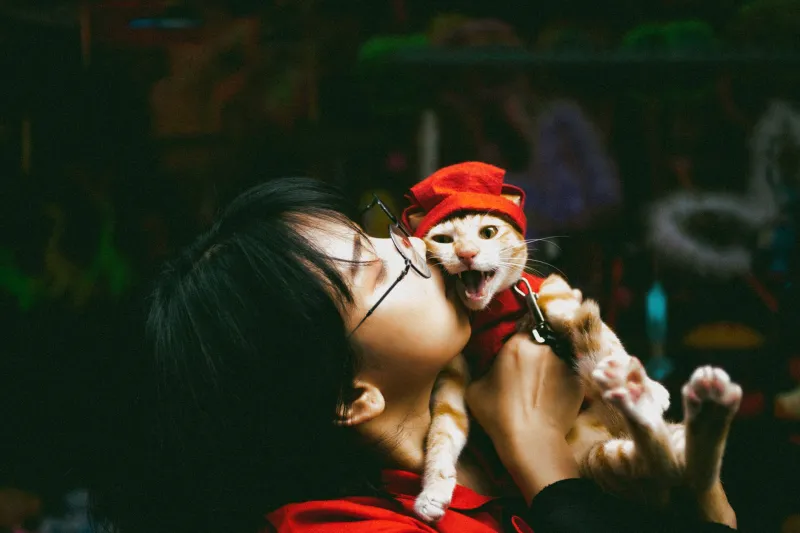
Let's be honest with ourselves for exactly one second. The moment you ordered a hand-sewn Sailor Moon uniform for a creature who legally cannot consent to wearing it, something shifted. You crossed a line. Not a moral one — we're not here to judge — but a cultural one. You stopped being a pet owner and started being a content producer. Your cat stopped being an animal and became intellectual property.
Welcome to the Cat Cosplay Industrial Complex. Population: your entire For You Page.
From Funny Hat to Full Character Arc
Pet costumes are not new. Halloween has been embarrassing dogs and cats alike since at least the early 2000s, when the internet was young and our collective need for external validation was only just beginning to metastasize. But what's happening right now is categorically different. We're not talking about a $6 pumpkin suit from Target anymore.
We're talking about Etsy sellers pulling in five figures a month hand-crafting miniature Demon Slayer uniforms, complete with tiny Tanjiro earrings and a little wooden sword. We're talking about cat owners commissioning custom crochet outfits to match specific scenes from My Hero Academia. We're talking about a cottage industry so niche and so lucrative that entire TikTok accounts exist solely to review the structural integrity of a Pikachu onesie on a Maine Coon.
The global pet costume market was valued at over $500 million in recent years and is climbing. Cats, historically resistant to literally everything humans have ever tried to make them do, are somehow at the center of this.
The Algorithm Wants What the Algorithm Wants
Here's the uncomfortable truth that every cat parent in a Discord server already knows but won't say out loud: the algorithm is the reason your cat is wearing a tiny samurai helmet right now.
Platforms like TikTok and Instagram don't just reward cat content — they reward escalating cat content. A cat sitting on a couch gets 200 views. A cat sitting on a couch in a business casual blazer gets 4,000 views. A cat sitting on a couch dressed as the entire cast of Attack on Titan gets featured on three separate meme aggregator accounts and briefly goes viral in South Korea.
This is not a coincidence. It's a feedback loop. Creators notice which costumes perform. Costume sellers notice which aesthetics get shared. The aesthetics that get shared are almost always the ones that tap into existing fandom energy — anime, video games, niche horror, retro cartoons. The cat becomes a vessel for nostalgia and parasocial attachment simultaneously. It's deeply weird and it works every single time.
The Parasocial Costume Community Is Absolutely Real
If you think the cosplay industrial complex begins and ends with individual pet owners dressing up their cats for clout, you have not spent enough time in the right corners of Reddit.
There are entire communities built around specific costume brands. Facebook groups with thousands of members dedicated to a single Etsy shop's aesthetic. Discord servers where people share "fit pics" of their cats and vote on upcoming themed photo shoots like it's a collaborative art project. Some of these communities have their own inside jokes, their own feuds, their own drama cycles that would make a reality TV producer weep with joy.
One particularly unhinged corner of cat cosplay Twitter — and we mean this as a compliment — has developed what can only be described as a shared cinematic universe, where various costumed cats are assigned recurring character roles and their owners write serialized photo captions like fan fiction. The cats, to their credit, look completely unimpressed in every single image. Which is, honestly, the correct response.
Sponsorships, Spon-Con, and the Monetization of Mittens
Here's where things get genuinely fascinating from a business perspective. Once a cat costume account hits a certain threshold — usually somewhere around 50,000 followers, though the goalposts keep moving — brands come calling. Not just pet brands, either.
Anime streaming platforms have paid for sponsored posts featuring cats in character-accurate costumes. Snack companies have sent free product in exchange for a cat in a branded chef's hat holding a bag of chips. A particularly famous cosplay cat account once partnered with a mobile game launch in a deal that, by all accounts, paid out more than some mid-level marketing jobs.
The gamification angle here is real. Pet owners who are serious about this space treat costume content with the same strategic intentionality that human influencers apply to their own feeds. They study which fandoms are trending before commissioning new outfits. They time releases around anime season premieres. They coordinate with other accounts for crossover content. It is, functionally, a small media operation — except the talent is a nine-pound cat named something like Mochi who would genuinely prefer to be sleeping.
What Does the Cat Think
This is the part where we are contractually obligated to point out that cats, as a species, have never once asked for any of this. The scientific consensus on whether cats experience embarrassment is murky, but the video evidence of a Persian in a full Hogwarts robe staring directly into the camera with the energy of someone who has accepted their fate suggests something is happening emotionally.
Most animal behaviorists will tell you that short-duration, well-fitted costumes don't cause harm as long as the cat isn't showing signs of stress. And to be fair, some cats genuinely seem unbothered — even weirdly cooperative — during dress-up sessions. Whether that's tolerance, confusion, or a deeply evolved survival strategy for living with humans is a question above our pay grade.
What we do know is that the cats who become costume stars tend to have owners who are extremely attentive to their comfort levels, because a stressed cat is also an uncooperative cat, and an uncooperative cat does not produce shareable content. Capitalism, in its own twisted way, has accidentally incentivized gentle handling.
The Costume Is the Bit, But the Cat Is the Point
For all the industry analysis and algorithmic cynicism, it's worth pausing to acknowledge why this actually works on us. A cat in a tiny Ghibli costume is funny because it's absurd. It's a small, dignified creature wearing the visual language of something enormous and human — fandom, nostalgia, cultural identity — and it doesn't care even slightly. The cat is the straight man in a joke the internet is perpetually telling itself.
There's also something genuinely joyful about a community built around making elaborate tiny clothes for animals. In a media landscape that can feel relentlessly grim, a Maine Coon dressed as Totoro is doing actual work. It is, in the most literal sense, a coping mechanism with a really good aesthetic.
Just maybe don't tell your cat you've already pre-ordered the Jujutsu Kaisen set. Let them find out at the photo shoot like everyone else.