When Cats Crashed the Culture War: How Whiskers Became the Internet's Unlikely Peacemaker
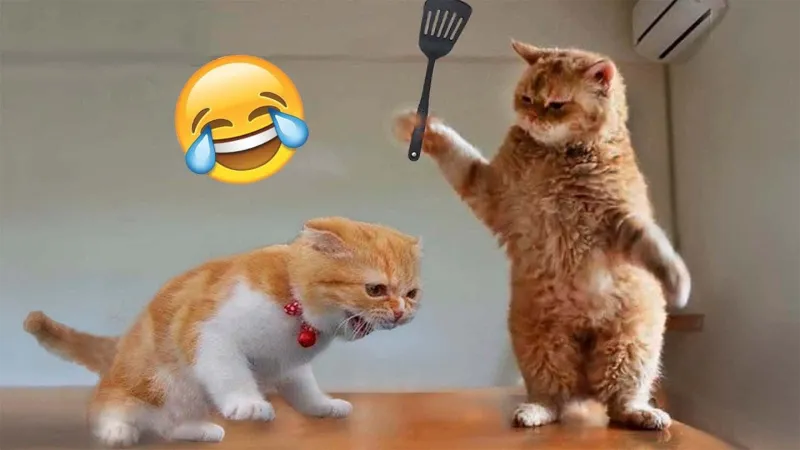
Photo: funny cat meme face close up dramatic expression, via wallpapers.com
Political meme spaces online have long been battlegrounds of pure, concentrated vitriol — the digital equivalent of Thanksgiving dinner if everyone at the table had a grudge, a WiFi connection, and absolutely nothing to lose. But something strange and soft-pawed has been happening lately. Cat content has quietly infiltrated the most divisive corners of internet discourse, and the results are genuinely bizarre, occasionally heartwarming, and probably more effective than any fact-checking initiative ever deployed by a well-meaning nonprofit.
This is the story of how cats crashed the culture war. And honestly? Good for them.
Pepe's Unlikely Roommate Situation
If you have spent any time in the weirder ZIP codes of internet culture, you know Pepe the Frog — the Matt Furie creation that went on a strange, decade-long journey from stoner comic to political symbol to reclaimed art project and back again roughly seventeen times. Pepe is, in many ways, the founding document of modern meme warfare: a neutral image weaponized, fought over, and ultimately rendered so chaotic that it means everything and nothing simultaneously.
Now imagine Pepe sitting next to a cat. Not metaphorically — literally. Over the past two years, a significant and measurable trend in meme creation has involved taking traditionally charged political imagery and simply... inserting a cat. A grumpy orange tabby photoshopped into a congressional hearing. A void-staring black cat replacing the central figure in a viral protest graphic. The infamous "this is fine" dog from KC Green's comic — itself already a meme institution — getting quietly replaced by a cat who looks significantly more at peace with the flames.
The effect is immediate and almost chemically disarming. The political charge does not disappear entirely, but it gets... fuzzy. Literally.
The Science of Cute as a De-escalation Tool
This is not purely anecdotal fluff (though we at CatPepe reserve the right to produce purely anecdotal fluff whenever the mood strikes). There is genuine behavioral psychology underpinning why cute imagery disrupts aggressive online discourse.
Researchers studying what they call "kawaii" effects — derived from Japanese cute culture but broadly applicable — have found that exposure to images of baby animals and infant-like features activates caregiving instincts in the human brain, literally shifting cognitive resources away from threat-response processing. In plain English: when you see a tiny kitten, your brain briefly stops being angry because it is too busy wanting to protect the tiny kitten. You cannot fully sustain righteous internet fury while simultaneously processing the image of a cat wearing a little hat.
Meme creators, who operate as intuitive social engineers whether they think of themselves that way or not, have discovered this effect empirically. "I started putting cats in stuff because it made me laugh," explained one anonymous meme account operator with over 200,000 followers whose content regularly navigates political territory. "But then I noticed the comments were just... different. People who would normally be at each other's throats were arguing about whether the cat in the meme was a Russian Blue or a British Shorthair. It was wild."
The cat had, without any intent or awareness, become a moderating presence.
The Cat-ification Taxonomy (Yes, This Is Real Now)
Not all cat-political meme fusions are created equal, and the community has developed its own informal taxonomy for how this works.
The Displacement Meme swaps a charged human figure entirely with a cat, neutralizing the specific person while preserving the structural joke. These tend to get the broadest cross-ideological sharing because neither side can claim the cat as their mascot — the cat belongs to everyone and therefore to no one.
The Reaction Cat Insert places a cat as a silent observer or reactor within an existing political template. The cat's expression — and cats have range — becomes the editorial comment. A deeply unimpressed tabby watching two politicians argue requires no caption. The tabby IS the caption.
The Accidental Crossover is perhaps the most culturally interesting: when a cat meme that had zero political intent gets adopted by a political community and transformed. The "woman yelling at cat" meme, originally just a TV screenshot and a confused-looking white cat, became one of the most bipartisan meme templates of the late 2010s precisely because both sides could project their enemies onto either figure. The cat remained blameless throughout.
Common Ground Has Four Legs and No Opinions
What makes the cat-political meme phenomenon genuinely worth examining — beyond its entertainment value, which is considerable — is what it reveals about the underlying mechanics of online polarization.
Most political meme warfare functions by establishing and reinforcing in-group/out-group dynamics. The imagery signals tribal affiliation before the text even registers. The cat disrupts this signaling because cat ownership and cat appreciation genuinely cross every demographic, political, and cultural boundary in American life. Cats are owned by conservatives and liberals, by city dwellers and rural communities, by Gen Z and Boomers who still call it "the Facebook."
When a cat enters the meme, it introduces a shared reference point that exists outside the political frame. For one brief, shining moment, the comment section becomes people arguing about cats instead of each other. That is not nothing. In the current media landscape, that is practically a diplomatic breakthrough.
Meme scholars — and yes, this is a real academic field now, deal with it — have noted that humor has historically served as a pressure-release valve in tense social environments. What cats add to that function is specificity. The humor is not at anyone's expense. The cat did not vote for anyone. The cat has not read the op-ed you are furious about. The cat simply exists, chaotically and magnificently, as a reminder that the universe contains things beyond the current argument.
Does Any of This Actually Matter?
Here is where we have to be honest with ourselves, because CatPepe is nothing if not a publication of rigorous intellectual integrity (and also a website with a frog-cat hybrid in its branding).
Cat memes are not going to fix political polarization. They are not a substitute for policy, for accountability, or for the hard work of building understanding across genuine disagreement. Anyone arguing otherwise is selling something, and you should not buy it.
But here is what they can do: they can create micro-moments of shared humanity in spaces that have become almost entirely dehumanized. They can interrupt the automatic escalation cycle that turns every online interaction into a referendum on someone's fundamental worth as a person. They can remind communities — even briefly, even imperfectly — that the people on the other side of the screen are also people who have, at some point, watched a cat fall off a counter and felt a complicated mix of concern and absolute delight.
Pepe the Frog's most interesting chapter might not be his political one. It might be the ongoing, chaotic, completely unplanned collaboration with cat culture — two great meme traditions, forged in the same internet fires, finding that they have more in common than anyone expected.
The cats did not ask to be peacemakers. They just showed up, knocked something over, and somehow made everyone feel a little better about the whole situation.
Very on brand, honestly.