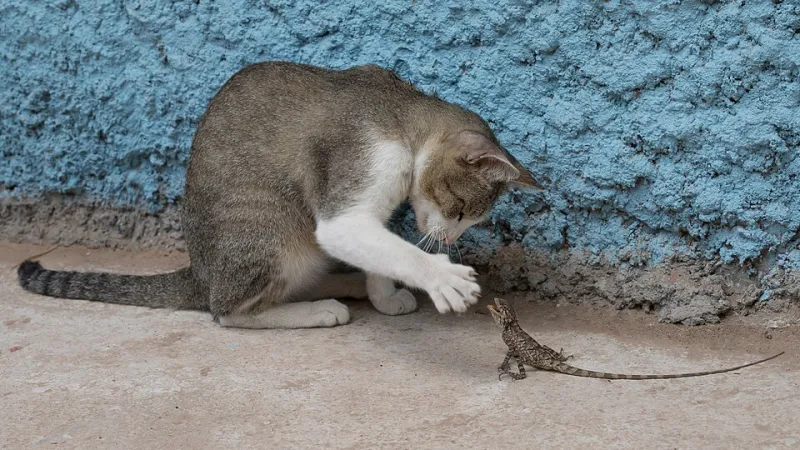
Algorithm vs. Tabby: Inside the Mysterious Force Quietly Killing Cat Content on Instagram

Photo by Photo by Swello on Unsplash on Unsplash
Something is wrong in cat internet. Not the fun kind of wrong — not a viral blep or a suspicious 3 a.m. zoomie. This is the quiet, bureaucratic kind of wrong, the kind that shows up as a graph trending downward and a DM from a desperate creator that reads: "My cat has 200k followers and her last reel got 47 likes. What is happening."
Welcome to what the community has started calling the Great Cat Filter Collapse — a slow-moving catastrophe playing out across Instagram feeds everywhere, in which cats, the undisputed monarchs of internet content since roughly 2005, appear to be getting quietly edged out by Meta's ever-shifting algorithmic priorities.
The Numbers Don't Lie (Even When Meta Won't Talk)
If you run a cat account on Instagram, you've probably felt it. Reach is down. Saves are down. That reel of Mr. Butterscotch doing his little spin move, which would've pulled 80,000 views eighteen months ago, is now languishing somewhere around 3,200. And it's not just anecdotal.
Several mid-to-large cat influencer accounts — we're talking follower counts in the 50k-to-500k range — reported engagement drops of anywhere between 30 and 60 percent over the past year, with no corresponding changes in posting frequency, content quality, or hashtag strategy. One creator behind a popular rescue-cat account based out of Portland told us she's been tracking her stats obsessively since early last year. "I've done everything right. I post Reels, I use trending audio, I engage with comments within the first hour. And my cat, who used to reliably hit six figures on video views, is now lucky to crack ten thousand. Meanwhile, I watch dog content and wildlife pages absolutely pop off."
That last part is where it gets interesting.
Dogs Are Eating (Cat) Content for Breakfast
Anecdotally and statistically, dog content appears to be thriving in the exact ecosystem where cat content is gasping. Multiple creators across Reddit's r/Instagram and various creator-focused Discord servers have posted side-by-side comparisons: identical format, identical posting time, identical audio — one featuring a cat, one featuring a dog — with the dog video outperforming by a factor of three or four.
Is Meta deliberately promoting dogs? Almost certainly not with any conscious intent. But algorithmic bias doesn't require a villain in a boardroom. It only requires a feedback loop. If early-stage engagement signals — shares, saves, comments in the first thirty minutes — happen to skew toward dog content because dog owners are, statistically, slightly more likely to share content to Facebook (still a Meta product, still feeding the algorithm), then the system rewards dog content more, which surfaces it to more people, which generates more engagement, which rewards it further. Cats, with their historically irony-coded, meme-heavy audiences who are less likely to be active on Facebook, could theoretically be getting quietly deprioritized through nothing more than cold mathematical indifference.
Which, honestly? Very on-brand for the internet.
The Shadowban Question Nobody Can Answer
The term "shadowban" gets thrown around loosely, and Meta has repeatedly denied that shadowbanning exists on its platforms. What does appear to exist, based on creator reports and third-party analytics tools, is something more bureaucratically sinister: content suppression tied to keyword flags, audio rights issues, and what the platform vaguely calls "sensitive content" filters.
Here's where it gets absurd. Several cat creators have reported that posts using common cat-related hashtags — including some variation of #CatsOfInstagram, which has literally billions of tagged posts — have been quietly removed from hashtag discovery pages without notification. One creator tested this methodically over six weeks, posting identical content with and without cat-specific hashtags, and found that posts without the hashtags actually reached more non-followers. Her conclusion: the hashtags themselves may be triggering some kind of soft suppression. She now refers to her cats exclusively by fake names in captions and describes them as "small chaotic roommates" to avoid the filters.
This is the level of psychological warfare we are dealing with.
The Workarounds Are Getting Creative (and Unhinged)
Creators are nothing if not adaptive, and the cat content community has responded to algorithmic suppression with the kind of chaotic ingenuity you'd expect from people who have spent years narrating the inner monologues of animals who do not care about them.
Current strategies making the rounds include:
- Posting cat content as "cooking videos" — specifically, framing the cat sitting near food as a recipe process shot. Apparently food content gets preferential treatment and the algorithm hasn't caught on yet.
- Tagging locations in unexpected cities — one creator tags all her posts as being from Marfa, Texas, because she read somewhere that geo-tagged content from "interesting" locations gets a reach boost. Her cat has never been to Texas. Her cat has never left the apartment.
- Disguising cat Reels as "day in the life" human content — opening with three seconds of the creator's hand or face before cutting to the cat, essentially tricking the algorithm into thinking it's people-focused content.
- Collaborating with dog accounts — yes, really. Several cat creators have started doing crossover posts with dog influencers purely for the algorithmic halo effect.
The dog collab pipeline is, genuinely, the funniest development in this whole saga.
What This Actually Means
Look, Meta isn't going to issue a statement saying "we accidentally deprioritized cats." That's not how any of this works. The algorithm is a black box wrapped in a terms-of-service document no one reads, and the company's incentives are tied to time-on-platform and ad revenue, not to the preservation of feline digital culture.
But here's the thing: cats were the original content. Before influencers, before Reels, before the entire creator economy existed as a concept, cats were what people logged on to see. Grumpy Cat, Lil Bub, the original LOLcats — these weren't just memes, they were proof of concept for the entire idea that user-generated internet content could be emotionally compelling and culturally significant.
If the algorithm is genuinely suppressing that lineage in favor of more engagement-optimized content formats, that's not just a technical glitch. It's a small, stupid, corporate tragedy playing out one throttled reel at a time.
Mr. Butterscotch deserved better. They all did.